

What is Anticapital?
From the polar periphery to RDP as the organized center of real socialism.

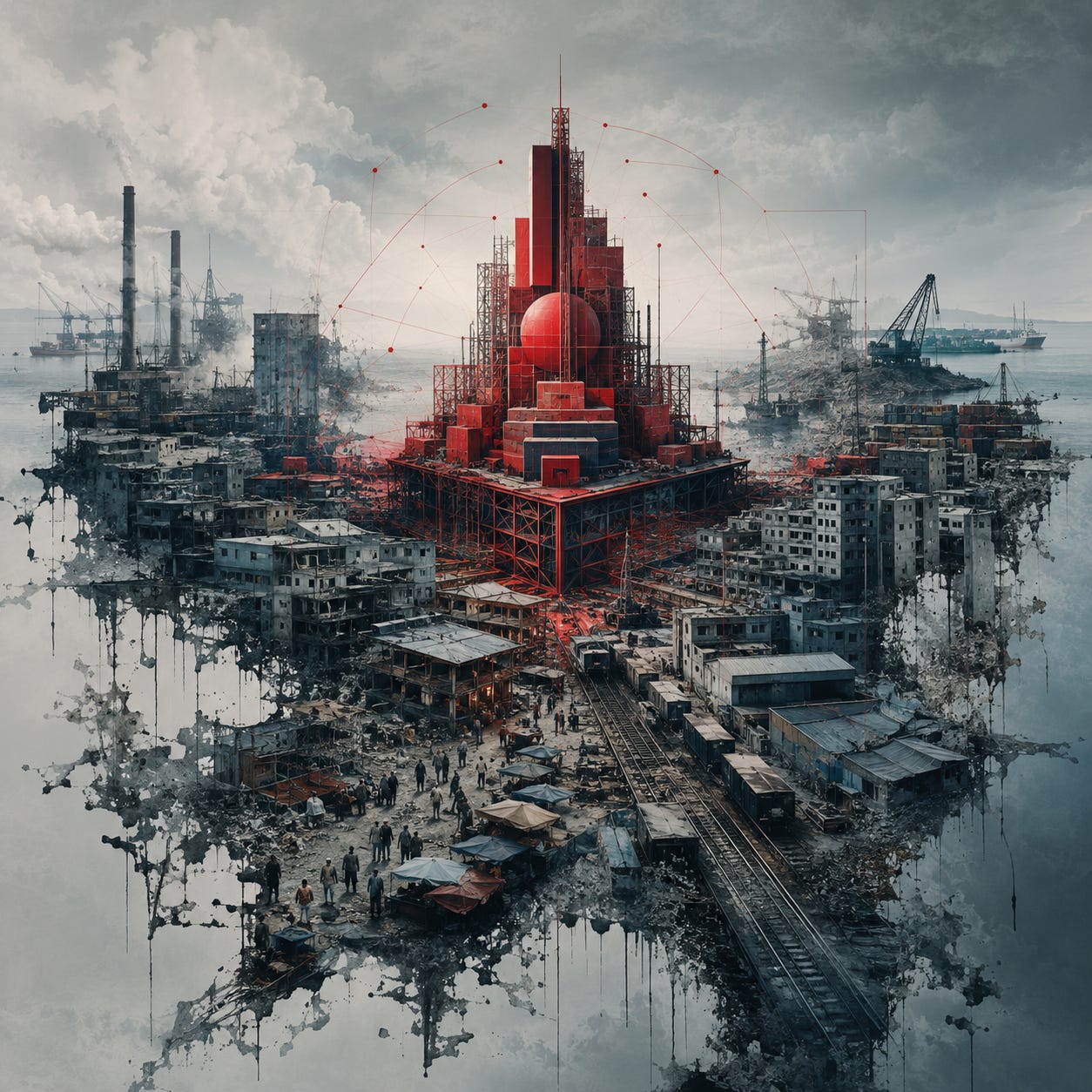
The polar periphery
Imagine a country where capitalist relations formally exist. People buy, sell, work, open businesses, seek profit, enter market relations, and try to live through capitalist relations. Everything seems to have the outer form of capitalism.
But the form does not harden.
One person tries to build a business, and it collapses. Another tries, and it also collapses. A few succeed, sometimes even on a large scale, but their success remains unstable, dependent, fragile, and constantly pressed from outside. The economy has markets, money, labor, firms, trade, and profit-seeking activity, but these relations fail to reproduce the country as a strong capitalist society.
This is the basic situation of the polar periphery.
The polar periphery is the periphery of the polar epoch: a world zone where capitalist relations exist under imperialist pressure and lose the ability to reproduce development in a stable capitalist form.
The polar periphery differs from the old pre-polar periphery. Before the birth of anticapital, the periphery was mainly a subordinated zone of the capitalist world. It was exploited, dominated, and held below the imperialist center.
In the polar epoch, the periphery remains oppressed, but it also becomes something more. It becomes the place where capital begins to fail as a reproductive form. Capitalist relations still appear there, but they cannot organize development in the same way as in the capitalist center.
Profit is not an eternal natural force. It works under definite historical conditions. It becomes a law of motion only when the whole structure allows capital to reproduce itself, accumulate, expand, and organize society around itself. On the polar periphery, this law becomes broken, distorted, and unstable.
This is why the periphery becomes the place where capitalism produces its own opposite.
Potential anticapital
The polar periphery becomes potential anticapital when capitalist relations lose their ability to reproduce development across it. Markets, firms, wages, trade, and profit-seeking activity continue to exist, but they fail to organize society into a stable and developed capitalist form.
The periphery tries to take the form of capital, but this form fails to harden into a normal capitalist path of development. It becomes a field of unstable relations, broken reproduction, dependency, revolt, and anti-imperialist pressure.
Potential anticapital is the condition of the polar periphery in which capitalist relations lose their reproductive force and begin to generate a movement toward another mode of development.
Potential anticapital appears through many forms: revolt, national liberation, socialist parties, anti-imperialist movements, revolutionary states, centralized developmental regimes, and new forms of political power. These forms differ on the surface, but they arise from the same historical condition: the failure of capital to reproduce the periphery as a developed capitalist society.
At this stage, anticapital exists as a tendency. It is scattered across the polar periphery. It already moves against imperialist domination, but it has not yet created its own stable center. It still needs a mode of production and an organized historical form.
Anticapital as a mode of production
Anticapital becomes real when the polar periphery creates production relations that reproduce society outside the direct logic of capital. The economy begins to grow, organize, industrialize, mobilize labor, direct resources, and build power through another logic.
This is the decisive point. Capitalist relations fail to reproduce development on the periphery. Another form then appears. This form organizes society, develops production, and gives the periphery historical direction. Since it arises against capital, under the pressure of imperialism, and from the failure of capitalist reproduction, it becomes anticapital.
Anticapital is the historical opposite of capital: a mode of development that arises from the polar periphery against imperialist domination.
Anticapital is a real mode of production. It is the organization of production, power, development, and social reproduction against the logic of capital.
The anticapitalist mode of production is the mode of production that emerges on the polar periphery when capitalist relations lose their reproductive force and a new system organizes development against capital.
The Soviet Union is the clearest first example. It emerged from the polar periphery under the pressure of imperialism, war, crisis, and capitalist breakdown. It created another system of development, another form of power, and another logic of reproduction.
This is why the Soviet Union was the first organized historical form of anticapital.
The center of anticapital
Anticapital must be understood in two senses: as a whole and as a center.
As a whole, anticapital is the entire field of the polar periphery where capitalist relations break down and begin to generate another historical direction. This includes national liberation movements, socialist movements, anti-imperialist states, developmental regimes, revolutionary organizations, and other forms that arise against the pressure of imperialism.
But these forms remain scattered while they exist only as peripheral reactions. A country can rebel against the West, build a dictatorship, declare sovereignty, or try to develop independently, but this alone does not create a stable anticapitalist path of development. Isolated peripheral forms remain weak, vulnerable, dependent, and easily pressured.
For anticapital to become a real historical force, it needs a center. This center is also the weak link in the strict historical sense: the point where potential anticapital becomes organized anticapital and creates a new mode of production.
The center of anticapital, or the weak link, is the organized form of alternative development through which potential anticapital becomes a real historical system.
The center is not necessarily a literal geographic center. It is a center in the historical sense. It carries within itself an alternative logic of development and creates a field of force in which the wider polar periphery can resist imperialism and begin to develop.
The Soviet Union was the first center of anticapital. It was the first true weak link of polar capitalism: the place where potential anticapital became an organized mode of production. Dengist China became the second great center of anticapital, where this same movement took a new historical form.
These centers do not merely support the periphery from outside, although direct support can also happen. More importantly, they create an alternative field of development. Within this field, potential anticapital can take shape, survive, and grow.
Without such a center, anticapital remains scattered potential. With such a center, it becomes a world force.
In ordinary language, this center is usually called socialism. More precisely, it can be called real socialism. In Polar Marxism, the exact name is the Revolutionary Dictatorship of the Proletariat, or RDP.
Real socialism is the common name for the organized historical center of anticapital.
The Revolutionary Dictatorship of the Proletariat (RDP) is the precise name for the organized form of anticapital as real socialism.
The Soviet Union was RDP of the First Type. Dengist China became RDP of the Second Type. Their difference belongs to another discussion. The important point here is that both represent the center of anticapital in different historical forms.
The polar periphery gives birth to potential anticapital. The center of anticapital turns this potential into an organized mode of production. This center is the weak link, real socialism and the RDP.
The meaning of anticapital
Anticapital is the opposite pole of capital in the polar epoch. It appears where the capitalist world reaches its limits and where the periphery begins to create another form of development.
It begins as the breakdown of capitalist reproduction on the polar periphery. It becomes potential anticapital through revolt, national liberation, socialist struggle, and anti-imperialist organization. It becomes real anticapital when it creates its own production relations. It becomes fully organized as RDP.
That is why these forms belong to one movement.
The polar periphery is potential anticapital in its scattered form.
The center of anticapital is the weak link, RDP, or real socialism in its organized form.
Together, they form the historical opposite of capital.